
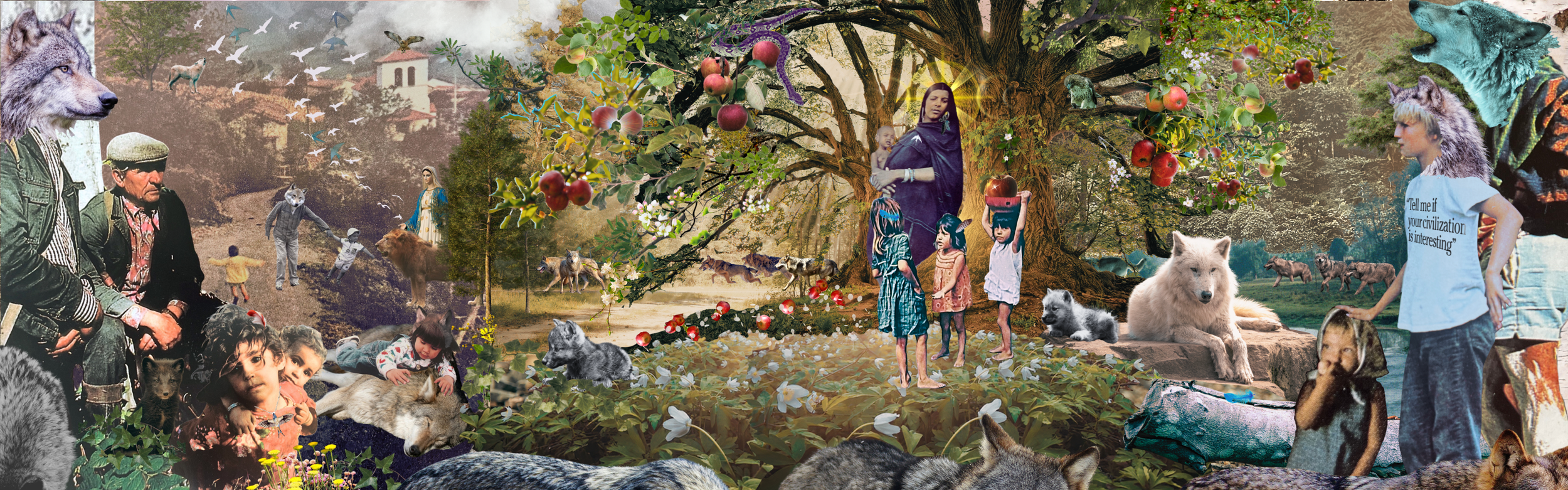
WOLVES AND MEN
A Brief History of Western Masculinity and an Invitation to Guardianship
Men once were wolves, vigilant guardians of the edge, the forest’s own kinetic reckoning. Before his people roused, vitalic man moved beyond the ember glow of the hearth to hunt alongside bear and lion — their paws soundless upon the soft abyssal soils of ancient time. Circulating from tree line to shore, his galvanic presence pressed upon the deer, heightening their vigilance and constraining their movements. Browsing mouths startled, trampling hooves sprang from the sapling whose tender roots reached hungrily down to form the shape and the filter of the river. In a downward ecology of influence biologists call a trophic cascade, the hunter rippled above the herd’s reach into the canopies rise, guarded leafy nest and birdsong, ensured the shaded clearwater of fish whose leap into the net would nourish the marrow of his people.
Near the village, the people dropped wild einkorn wheat and barley seeds upon fulsome soils, planted fruit and nut orchards, bringing forth an abundant age full with strong infants birthed from the well nourished hips of the women. Men matched the strength, danger and sacrifice of woman in her blood and pregnancies burden, ensuring she and the elders — the diamond of the kin-body — remained gathered around a protected hearth center, to tend in prayer, story and medicine to the young who would carry the people forward. When vitalic man returned from the forests roaming with fish in his net, the signal he sought was older than praise — the mother’s ease, the elder's nod, and the children’s calm as they played, ate and slept.
As the people grew in abundance along with the barley, they stopped their roaming. Whole forests were felled for cereal fields as the eon’s trees were dismantled into metals smelting fuel. Cast by storms into choked deltas, the last exhausted soils coursed away revealing the Earth’s stricken bones beneath, Children starved and mothers wept as the dying wisdoms of a disappearing world collapsed with their elders into graves. The deer and the auroch fled, harvests failed — until all were forced into reliance on dwindling cereal grains defended from neighboring clans, guarded in meager hope of survival.
When the clay Linear B tablets of Greek Mycenea were finally deciphered by archaeologists, they were not found to preserve the epic poems or prayers of the Palace. Instead, marking ration lists they found an administrative account of grain, oil and livestock — and among the tallied, once sovereign men of a formerly vital world, now enclosed and dependent on a centralized grain surplus within a reallocated feed system. Men, managed and accounted for among heads of lamb and ears of grain, overseen by administrators and priests who implored the gods to keep the harvests flowing. When finally the overtaxed hillsides gave way under centuries of relentless production, the temple gears ground to a halt, collapsing the king’s power and the palace walls.
Within a single generation, the common worker was left wandering, unskilled, scratching acorns and vetch from a denuded landscape. Without the towering symmetry of the Lion’s Gate or the temple’s reassuring rhythm upon which to orient his horizon, the collapse-survivor found himself tormented by a parasitic ache to return to the life he knew before the gods forsook him — an age now sealed forever against him. Standing an average of five foot two, malnourished, pock-boned and anemic, he gazed up at the great stone ruins, dug at the graves of the kings, held the impossible weapons and long bones of men who’d lived and died as giants. Considering the ruins and the bones, the poets answered the incomprehensible strength of an arm that could lift such weapons and such walls — made into divine men of legendary blood and name, mythic heroes of unforgettable deed. While the forsaken scrubland wanderer choked on vetch and picked as a quail at dry legumes, the remains of better men haunted him — men who strung their bows effortlessly, hurled spears that always hit their mark; men who feasted upon the roasted flesh of lions while wearing their sovereign skins.
Western Civilization’s earliest man became a ghost, nostalgic for the feast, trapped and aching after a lost grace. In a world vacant and stripped of its marrow, he stood bleak on the grey stage of Hesiod’s Races of Men, blocked forever from a once shining age where men had lived free from toil and grief, feasting from the earth as she bore her fruit unforced. Unable to return the auroch to the dismantled forests of his dismal inheritance, he turned to struggle against his neighbor — and what remained of himself — in a relentless hastening after prestige. Agon — the ruthless contest “to always be the best before others,” to win immortal glory and carve an unforgettable and heroic name — this became the organizing principle of the post-collapse man’s existence. In an uncertain world where emptiness pulled iron heavy on the soul, a man must gather all his strength and raven as a beast straight into the fold of men.
While beyond the edge of a failing light, the lion and the wolf still roamed, twin guardians at the edge of a once sovereign world.